Last month, Belgian jobsite StepStone launched a study on diversity in the workplace. Now, those results are being contextualized with results from France, Germany and the United Kingdom. In total, almost 17,000 European employees were surveyed and asked about diversity, inclusion and discrimination at work.
Employees in Belgium think diversity and inclusion at work is more important than other European colleagues think it is
In research earlier this year, StepStone unveiled that more than 8 in 10 (87%) think that diversity at work is an important topic and would find it positive to encourage it. Compared to the United Kingdom (83%), France (79%) and Germany (71%), this means that the surveyed Belgian employees found diversity to be the most important out of these countries.
For employers, too, there is benefit in this. No less than 81% of all surveyed Belgian respondents said they would find it motivational if their company were committing to greater diversity. Here, as well, this result was higher than the other surveyed countries; the United Kingdom (72%), France (74%) and Germany (67%).
Similarly, 92% of Belgian respondents would find it motivational if their employer actively promoted equal career opportunities. For the United Kingdom (81%), France (86%) and Germany (64%), these percentages of people affirming this statement were lower, too.
Employers are rated remarkably similarly regarding diversity across Europe
Inclusion and diversity might be more important for the surveyed Belgian employees, but when it comes to rating their employers on how well they are doing in terms of diversity, there is little difference.
When asked how employees would rate their own employer on inclusion and diversity, the results were as follows:
- Belgium with 66% of surveyed employees rating their employer as doing (very) well regarding diversity and inclusion at work
- Germany with 65%
- France with 64%
While Belgium has the highest result, the differences in percentages compared to Germany and France are negligible. For the United Kingdom, no valid results were available for this specific question.
When applying for a job, diversity is important for Belgian employees – but even more so for other countries
With more than half of the surveyed Belgian employees (63%) saying they would more likely apply for jobs in companies that publicly show themselves as tolerant, it is clear that this is important for the job seeking Belgian.
However, when compared with the United Kingdom (75%), France (72%) and Germany (77%), the percentage among surveyed Belgians is the lowest out of these four countries. For other neighboring colleagues, the topic of diversity and inclusion when applying for a job is thus even more pressing.
Belgian employee thinks (s)he could be discriminated against faster than other European colleagues
While a whopping 71% of all Belgian respondents stated that they had already been discriminated against at work, France scored even worse with 78%. For the United Kingdom, this was only 40%.
Unfortunately, the potential for discrimination is there, according to most respondents. When looking at participants’ own characteristics based on which they could someday face discrimination at work, Belgian respondents fear they could be treated unequally more than other surveyed countries:
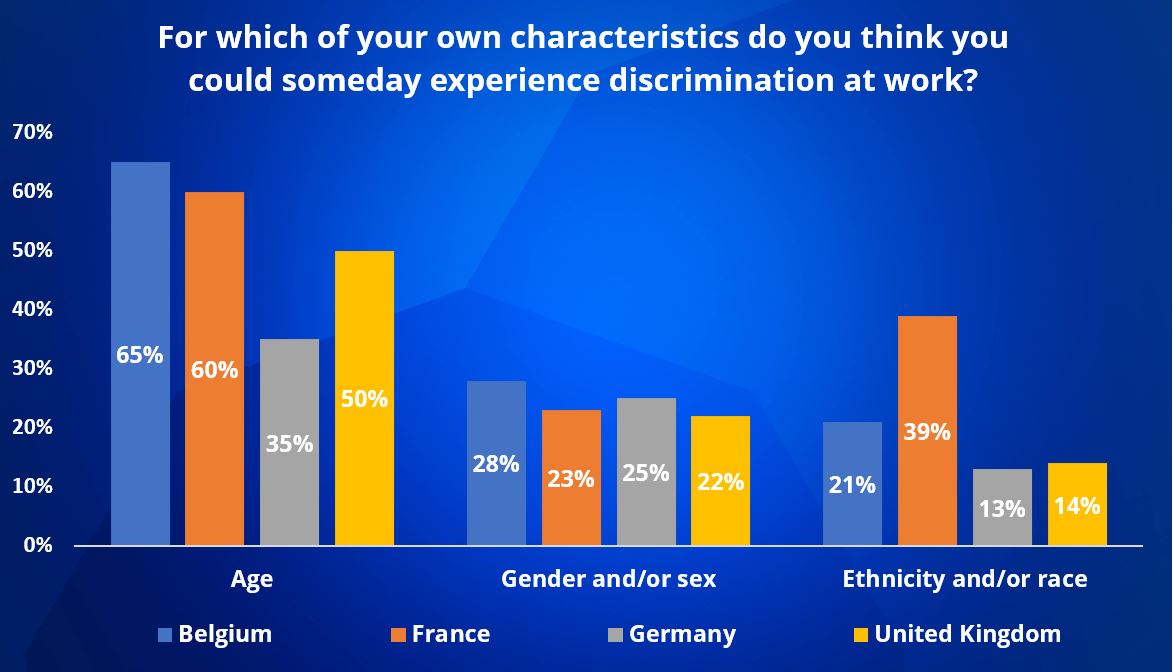
As noticeable in the graph, Belgian respondents score remarkably high among the three most mentioned potential reasons for discrimination.
Firstly, Belgians think their chances of discrimination based on age and gender and/or sex are higher than all other surveyed countries.
Secondly, they rank second highest in terms of potential discrimination due to ethnicity and/or race.
Thirdly, for the fourth most mentioned reason – discrimination due to parental responsibilities – Belgians think their chances highest as well, with 19%.
Miet Vanhegen, legal adviser at Belgian HR services and consulting group Acerta adds: “Discrimination in the labour market can occur at any point in the employment relationship: at the time of recruitment, during the execution of the employment contract or at its termination. It can be a conscious or unconscious attempt to discriminate against someone (direct discrimination) or the indirect result of a decision or procedure (indirect discrimination). However, Belgian anti-discrimination law provides for strong protection against discrimination. In case the employee thinks he/she is a victim of discrimination, he/she can report it or file a formal complaint.”
“A complaint can also possibly lead to a case before the labour court. There are various sanctions, which should not be underestimated, associated with discrimination in the workplace. An employer can e.g. be sentenced to a fixed compensation equal to six months’ gross salary. Unia reported in her 2019 annual report that the majority of the discrimination files were on the domain of work (28% of the total number of files).”
Belgian companies are trying to do better regarding diversity and inclusion – which most employees confirm
StepStone also checked with 292 Belgian managers and asked them about their recruiting practices regarding diversity and inclusion.
When asked if they are paying extra attention to diversity in their team when recruiting, more than 3 in 4 (76%) confirmed this. 39% of them pay a great deal of attention to this issue and another 37% simply acknowledge paying attention to it. The remaining 24% stated that they rather not or not at all pay extra attention to this topic when recruiting.
This increased attention also seems to be confirmed by employees: almost half (49%) says their employer has moved towards greater diversity in the last three years.
The Centre for Equal Opportunities Unia offers “www.ediv.be,” a website with online training modules, analysis of sample situations and a library to better deal with diversity in the workplace.
“Diversity is a big topic and you are not alone in tackling this”
Karina Volkhemer, HR Manager at StepStone Belgium, adds: “At StepStone, we have organically grown to become a very diverse company with over 20 different nationalities & we will be actively looking for the input of our employees on the topic of inclusion via an internal diversity committee. Aside from this organic evolution throughout the years, we have a zero–tolerance policy regarding discrimination and are continuously looking at implementing other supporting guidelines, like using inclusive language in job postings.”
“For other companies, I can advise to firstly assess the current situation in your company and the potential needs & wants. How do employees feel about this topic? And do they feel included? A simple survey can do wonders here. Then you have to turn these findings into action points and create the necessary change (if needed).”
“Aside from this advice, we shouldn’t forget that diversity is a big topic and you are not alone in tackling this. Luckily, there are plenty of official entities or professional inclusive agencies, which can provide further support.”
Methodology
With diversity at work, we mean the diversity of employees within one organization. We are not only talking about differences in gender and culture, but also, for example, age and nationality.
With discrimination at work, we mean the unequal treatment of employees and cases, based on age, disability, sex(ual orientation), gender, health, political or religious beliefs, social customs, ethnicity or nationality.
StepStone completed this survey for the Belgium specific data in November 2020 and collected the datasets from StepStone Belgium’s database with both employees and employers. In total, there were 2,394 filled in surveys submitted in Dutch (1243), French (836) and English (315). Additionally, in Germany, France and the United Kingdom, over 14,500 participants were surveyed.