More than half of female employees (55%) says that they have already been confronted with inappropriate behavior at work; while 25% of their male colleagues said the same. Among other things, the most common forms of such behaviors are stated in this study as well.
In light of the #MeToo movement and a growing focus on these issues over the last years, StepStone surveyed over 5000 Belgian employees regarding inappropriately and sexually transgressive behavior at work. The Belgian job site intended to map the occurrences, involved parties and accompanying feelings in order to spread awareness on this sensitive and important topic.
Important note: This data provides a snapshot of the situation before the Covid-19 crisis, increased homeworking and was collected in December 2019-January 2020. The results could thus differ since these impactful changes, but still give a view on the professional situation pre-corona.
1 in 2 of female and 1 in 4 of male colleagues already felt inappropriately approached at work
When asked whether they felt that they had already been confronted with inappropriate behavior at work, 40% of both genders confirmed this statement. Broken down, we notice that 55% of female colleagues felt this way, while for male workers, this was 25%.
Regarding participants being confronted with the inappropriate behavior, 80% mentioned being offended. The difference between male (70%) and female (82%) here was less substantial.
There were no significant differences between Dutch, French or other language speaking colleagues regarding above results – this ended up being less than one percent point.
What are the most common forms of inappropriate behavior?
The most common forms of inappropriate behavior at work were remarkably similar for everyone – regardless of language or gender:
- 49% was already confronted with ambiguous remarks at work
- 47% with frequent inappropriate jokes
- 34% with unwanted physical contact
One interesting difference can be noted regarding remarks on someone’s look. Female employees were frequently confronted with remarks on their own appearance (43%), while for their male counterparts, this was 16%. The amount of remarks on a colleague’s appearance (and thus not their own’s) was similar with 30% for both male & female.
But who committed these forms of behavior? In almost half of the cases, it was a colleague in the person’s team (46%). Secondly & thirdly, we see that the person’s manager (37%) & a colleague in another team (35%) were also mentioned.
2 in 3 of Belgian victims couldn’t speak up about it at work
Regarding communication of an incident of transgressive behavior, the respondents seem less inclined to mention this to the right parties at work. Only 15% would talk about it to their manager or HR department, while 30% did speak up to a colleague.[2]
“Being able to speak up in a non-violent way is a crucial step in the prevention of unwanted conduct. Hence it is important you can indicate your limits. The fact that we cannot speak up makes also that the number remain high.”, Professor of Occupational Medicine at KU Leuven Godderis clarifies.
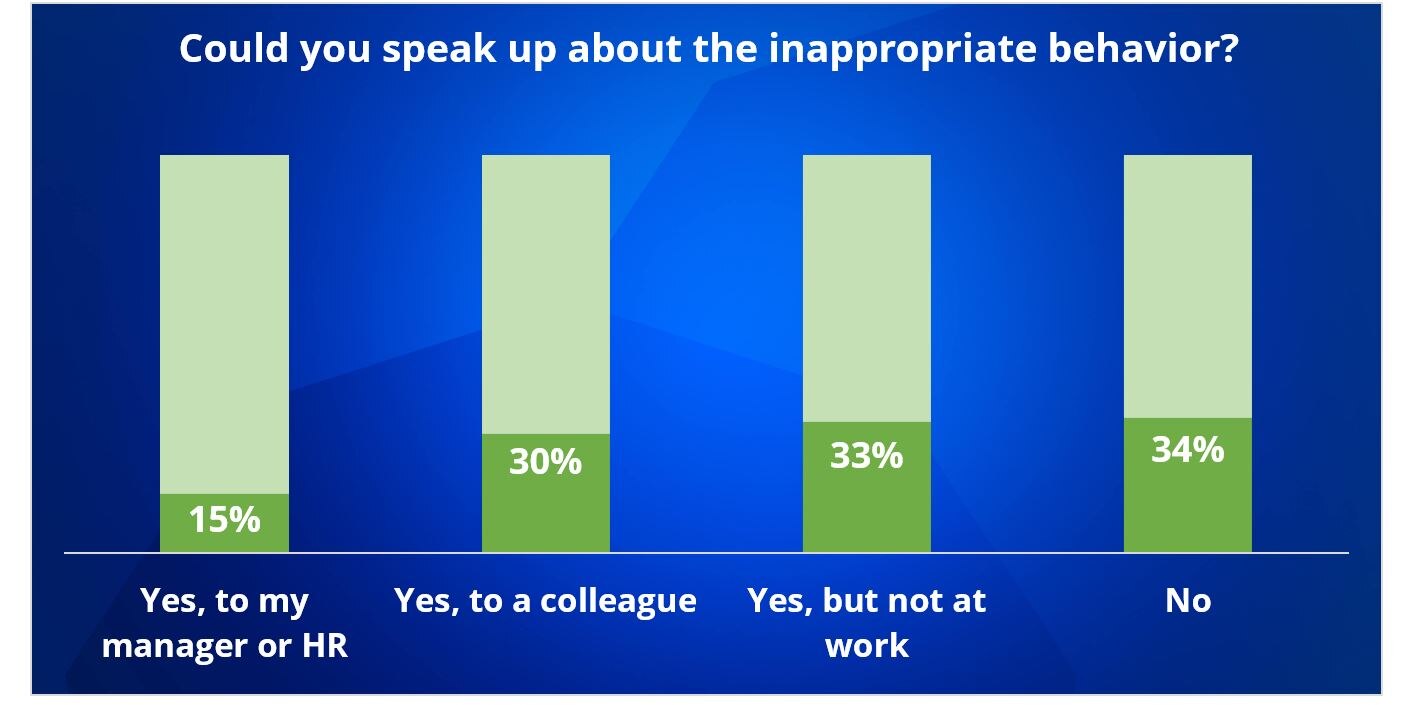
However, 33% would speak up, but not at work, and 34% said they couldn’t speak up at all. This amounts to 67% of people not being able to speak up at work about such an incident.
A deep dive into the data shows only one significant difference between male or female employees. It seems that male employees feel less inclined to talk about it at work (68%) while for female colleagues, this was 65%.
Broken down per language, we see that Dutch speaking employees are more eager to speak up to the relevant departments and persons at work. The results show that 16% of them would mention such an event to their manager or HR, versus 13% of French speakers.
The same trend goes for mentioning it to a colleague, where 33% of the Dutch speakers would do this, versus only 27% of French speakers. Additionally, “only” 63% would not speak up at work, versus a significantly higher 70% of French speaking colleagues.
Companies are trying to do better & bring this issue to light
In the last 12 months, 18% of the Belgian employees has had the opportunity to take accessible trainings or guidance on appropriate behavior at work. For 1 in 3 of them, this was the first time their company had issued such a training. Overall, 80% of employees felt this training or guidance at work was necessary.
Professor of Occupational Medicine at KU Leuven Lode Godderis underlines the important roles of companies: “Despite the #metoo campaign transgressive behavior remain s very prevalent at the workplace. This indicates the need for setting up a policy in companies and a plan to implement it at the work floor. The availability of a policy is not sufficient, enterprises need to follow up on it.”
A zero-tolerance policy in a safe work environment
Karina Volkhemer, HR Manager at StepStone Belgium & the Netherlands, adds to this that unsafe or unwanted behavior at work cannot stand: “Often, small examples of unwanted behavior can be shown at an early stage – and that’s where we try to intervene already. Moreover, to be able to allow this to happen, we need to create a culture where people feel safe to speak up which is the essence of creating this safe environment.”
“At StepStone, we go for a zero-tolerance policy and strive towards a safe environment for our employees. Our management has a crucial place in this ongoing project as a leading example.”
“More concretely, our HR department organizes obligatory trainings on this topic for every new employee where we explain our clear policy towards inappropriate behavior. A crucial part of this message is that we have a ‘act quick, resolve quick’ approach and that all our employees have co-responsibility of taking care of the problem.
Professor Godderis also adds: “I recommend for supervisors to use in their feedback a compassionate communication technique, which starts with talking about the facts (what one can observe), followed by expression of the perceived feelings. Next, the supervisor can express the needs and formulate the request towards the collaborator.”
Methodology
Under inappropriate, transgressive or inappropriate behavior, StepStone understands behavior from someone at work that made you feel uncomfortable or uneasy. Both physical & psychological/verbal apply.
Regarding the demographic spread, we interviewed 5019 Belgian employees and employers of which 50% was male vs. 49% female; 39% was Dutch speaking vs 50% French speaking and 11% English speaking. The data was collected from December 2019 until January 2020.
Disclaimer
If you feel the need to talk about an incident or have ever been confronted by gender discrimination or transgressive behavior, please visit Instituut voor de Gelijkheid van Vrouwen en Mannen, SeksueelGeweld.be (ViolencesSexuelles.be), or 1712 where the necessary help & support can be provided.
[2] In the data, we allowed for overlap between “Yes, to my manager or HR” & “Yes, to a colleague” where both options were available to the respondents. The full amount in the graph thus does not amount to 100%.